The Status Quo

There is a key point that I always keep in mind when hiring new teachers: We do not want the teacher we hire to become more like us; we want our school to become more like them. The gist of that statement comes form Todd Whitaker in his book What Great Principals Do Differently or maybe it was from a presentation I heard him do but either way I’ve always attributed the thought to him.

By this tenet I want to be an organization that continually grows. I never want to become stagnant in the way we think or the way we interact. New blood allows us all to become better; challenges us to change for the betterment of our kids. While I’m a proponent of allowing autonomy among the teachers, I also understand that everyone has an impact on everyone else. Ask not for whom the bell tolls…and all that! Which leads me to the status quo and this blog post by Greg Miller: You Weren’t Hired to Maintain the Status Quo.

The post came at a very important time for me. Having just completed interviews for a teaching position I was left with the undesirable decision of whether to hire a new graduate or an applicant who had extensive substituting experience in the district. I chose the candidate that best fit my tenet from above: Which candidate do we want our school to be more like? While I will hang my hat on the fact that the best applicant for our students was chosen, it was still one of the hardest phone calls I’ve ever had to make. The easy decision would have been to hire from the substitute pool but the interview team felt that this applicant made our school better and I couldn’t disagree. In Dr. Miller’s blog he quotes Dr. Justin Tarte, “You weren’t hired to maintain the status quo; you were hired to make a difference and make an impact.”

Dr. Tarte and Dr. Miller were using that statement to talk about hiring teachers. It is also important to remember as administrators. Whoever hired us didn’t do so because we were exactly like the last person. We were hired to make our schools and districts better. We were hired because someone thought we could make an impact. We were hired because we are risk takers and capacity builders.  We were hired because we love kids and someone believed that these kids deserved us. We should never lose sight of that. Sometimes that means making the tough choices. It means upsetting someone as well as the status quo. It means always making the students the focus of your decision making. And it means that sometimes people aren’t going to like us.

Another motivational guy on Twitter, Salome Thomas-El put it this way:


That sounds tough but it’s true. Our jobs aren’t easy and we shouldn’t need to be told that. We chose to be the people who have to make tough decisions and as long as we are making the right decisions for the right reasons we should be able to sleep at night. All of us know people who have chosen not to take that step into administration. This is a big reason why. Does it make me feel good that every year I have fewer friends? Not really. Is it easy for me to see my wife’s disappointment when community members avoid her? Not at all. Does it make me feel good that I am making decisions that positively impact students? You bet.

Besides that, I like dogs.
For Hattie on Graduation

When I think about everything that has happened over the last 18 years, I am amused, honored and amazed. I know it is cliche but it really does go fast. If I only had one piece of advice for you it would be this:  Live in the moment! Don’t forget that this is the only life that you have and probably the most important thing is to suck the joy, pain, fun, sadness out of every moment. All of those things are what makes us who we are and they all have a purpose. One of the few regrets in life is that I worried about important moments and never really sat back and felt them. Living the moment is important.


I also want to say that you have come a long way, from a student who experienced some early difficulties to an honor student and a member of the National Honor Society – I never would have guessed it. That is the thing that I am most proud of today. Your athletic ability was a gift to me that made my life more enjoyable over the past several years but truly your hard work academically impresses me so much more. No one gets to have everything but you went out and worked to get what you needed; what you wanted. Being gritty is important.


One thing that I want you to know about today: This is your graduation from high school. It is a great thing to celebrate but remember it is only an interval of where you are going. For some kids today may be the apex of their lives. For you, my hope is that you will understand that this is but one major event in your life and the greatness will continue. Mackenzie’s Nono, Mr. B, once told our class that if he saw us in ten years walking down the sidewalk with our varsity jackets on he would know that he had failed. He wanted high school to be our springboard into great futures. All the high school accomplishments are considerable but they don’t amount to anything in the real world if you don’t continue to grow. Growing is important!

I love you and like any parent I want you to have it all. Over the next few years you will grow more and more independent. You will continue to live every moment, you will continue to be gritty and you will continue to grow. Through all of that remember that I am always here for you but not as a crutch. Your life from now on will be what you choose to make of it. Make good choices, make good friends, and make good connections. Don’t be afraid to make mistakes, don’t be afraid to take chances, don’t be afraid to live out loud but always remember that your dad is only a phone call away and he will always be your biggest fan.

Running for Answers

Image


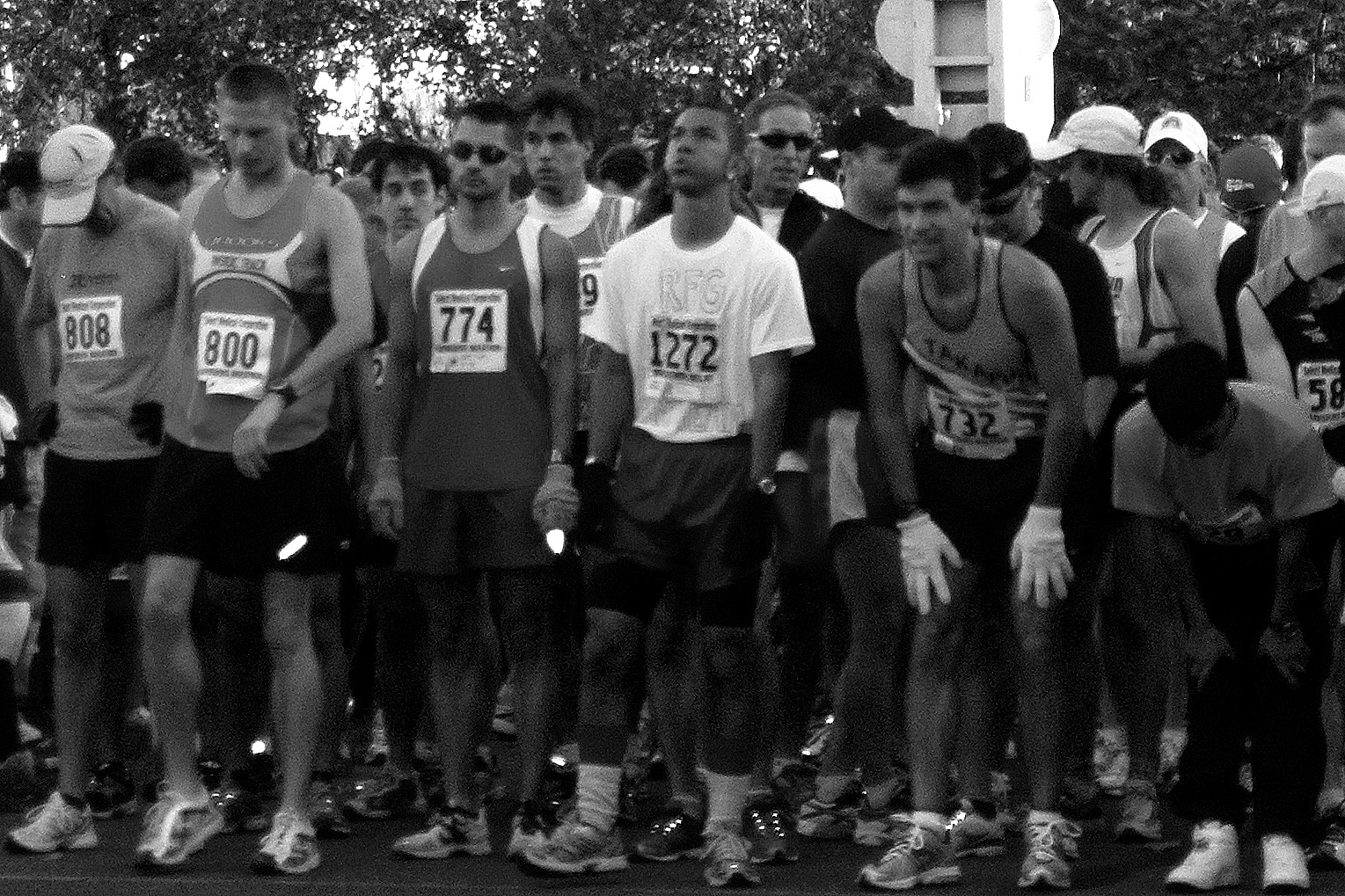
Harrisburg Marathon Start 2008 by the author

On Saturday morning I went out for a little 17 mile run. Sure, 17 miles seems like a long way. Further, I would guess than most people drive to work in the Northeast. Further than most people have to travel to a proper grocery store. But I was running it. And running it quite well for a 46 year old guy. As I ran, I started to contemplate how I got here. Who in the hell voluntarily runs 17 miles? I have never been an athlete but I have done the marathon distance before – twice. Why? Not sure about that. But the following is what I thought about during that run:

Over 20 years ago at the age of 25 I decided I was out of shape and aging faster than I wanted to. I started getting in to running. I went out and bought a pair of “cross trainers.” Now anyone who is reading this that considers themselves a runner knows that you can’t be a runner in cross trainers. I was green and in those days I didn’t even know what questions to ask. I started out humbly, not even able to run a mile. I bought my first pair of running shoes and eventually I got up to where I could run three miles without falling down. I thought I was in great shape. I entered by first 5K. 3.1 miles. I was an athlete now! I could do this. I ran 27:56. Which if you are not a runner is precisely 9 minutes per mile. I thought that was awesome. I got beat by old ladies and guys who had a hitch in their giddy up. I had no idea how slow I actually was. I was embarrassed and determined to get better. Eventually I ran a personal record of 22:47. Not many years after that first 5K, I read an article about training for a marathon. It didn’t sound that difficult. So, just a month after my 31st birthday I ran my first marathon and followed that up with a second marathon the following year.

So 14 years after that second marathon, what am I doing on a country road 8 miles into a 17 mile run and seemingly in pretty damn good shape? Well that is another story that will wait for another time but I did begin to contemplate what I have learned from running and why I felt relatively good for an old man training for his first marathon in over a decade.

  1. It’s easier to run a marathon than it is to train for one. Marathon training is long, boring runs on early Saturday mornings with no one cheering you on. Marathon courses are usually lined with people and other competitors and they give you food and drink along the way. You don’t get that in training. The lesson: The hard work is usually done behind the scenes. What gets you to the show is the practice, the studying, the time you have committed to your goal.
  2. Running a marathon is mentally more difficult than it is physical. Sure, there are morning when I can’t walk down the steps because my calves are inflamed. There are nights when I can’t sleep because my hips hurt so badly. But the worst thing is allowing your brain to convince your body that this won’t kill you. It takes a strong, positive mind to get yourself out of bed on a cold Saturday morning, hit the road and keep moving. Lesson: Much like above. There are times when you are working towards a goal and you just want to hang it up. It gets too hard. Your professor tells you that you’re not good enough, your family and friends think you;re nuts. The reality is that this is your goal and your work. You get to decide whether it is worth it or not. And you can decide that its not but let it be your choice.
  3. Running hurts and running fast really hurts. Sometimes you have to run fast or do harder workouts to get better. You may get better at these workouts but they will never get easy. Running repeats on a track, doing hill repeats, running 17 miles will never be characterized as easy. Same goes with life. If its getting easy you probably aren’t doing it right. If you are spending too much time in your comfort zone, you are not getting better – at anything.
  4. On the flipside, sometimes you have to go slow. We are in training, we don’t need to kill every workout. Some workouts are for developing stamina and those workouts are slow. Slower usually than marathon pace. Same goes for life. You also need to take the time to relax and enjoy life. Six minutes miles will get you to the finish faster which is good in a race but probably not in a life.
  5. Training for this marathon I feel much better physically than I did 14 years ago and I’m running the same if not slightly faster pace than I did back then. In fact I have run personal records at every distance but the 5K in my 40s. Getting older apparently has its benefits. I have already made the mistakes. At 25 I didn’t know what questions to ask. In my 30s and now in my 40s I have made the mistakes and learned from them. I have asked the questions and had them answered. The lesson is that there really is no replacement for experience. Easily the best teacher in many ways. Experience doesn’t necessarily mean that you learned it on your own but it means that you have learned what to ask, where to look for answers, and who to give your trust to.


So I’ll keep running, and asking, and answering, and learning

Progress?

Ok, so as I’ve been reminded, the last post that I made promised updates on my progress. It is probably apparent to some that my progress was not what I had hoped. Unlike Niall at Disrupting the Rabblement, I found it very difficult to take time everyday to log my progress. This is probably a habit that I need to develop. My personality doesn’t lend itself well to keeping track of things. I’ve been a runner for more than 20 years and am probably one of the only runners that I know that doesn’t keep track of mileage, times, races, etc. I’ve tried but I lose interest after a couple of weeks. Sometimes it would be nice to be able to compare where I am now as a runner to where I was 20 or 15 years ago but it doesn’t really concern me on a daily basis. Same goes for this daily tracking of habits.

After a couple of weeks of tracking my habits, I realized that it was more stressful than I wanted it to be. Forcing myself to do things rather than letting them flow and doing them because I want to leads to a modicum of stress. I posted a new photo on my blog for two plus years. It was a great experience and really helped to improve my photography. After awhile though it gets stressful to constantly be looking for a shot that is good enough to post on a daily basis. I have considered in the past few years running another marathon. At some point, the tress of knowing that you have to run takes the enjoyment out of running. I didn’t want this to be stressful, I wanted it to be rewarding.

After some thought I decided that there were two things that I really wanted to do. Train for a marathon and practice Spanish. On those two fronts I did pretty well. With the exception of the few days that I was ill in January, I have run at least five days a week and have worked my long run up to 14 miles. Given the weather in the US this winter, it is probably obvious to many runners that many of these miles are on the treadmill. On the Spanish frontier, I have been using a program called Duolingo. Using this program I practiced for 28 days in January including a streak of 19 days in a row. I highly recommend the program and love the back story especially its roots in Pittsburgh. For no cost you can practice online or on the iPhone/iPad app

The one thing that I would like to get better at is limiting the television more often. When I got sick early in January, the only thing I wanted to do was lay around. I didn’t feel much like reading, writing, photography, etc. So I watched TV. The northeastern weather hasn’t helped much either. The snow doesn’t bother me so much but the frigid temps have kept me on the couch more than I had hoped. Excuses, I know. 

The other thing that has kind of slipped is my decision to read more. I have no excuses for not reading more. I’ll get to it.

All of that being said, I’ve decided not to be Niall but to be Jeff. The habit I am going to track are Reading, Running, Spanish, and No TV. I will try to update more often and post photos.

Happy New Year

It’s been a while since I posted. I know. It’s been a busy year and a the end of it has left me with little to add. As I reflect on the year I realize that I abandoned the blog because it wasn’t really making a difference. I wasn’t really saying anything new. I read blogs all the time and there is a lot of conversation about what is wrong with education, what is wrong with the world and they aren’t really creating change. Maybe some people feel better by complaining about what suck about this and that but it just makes me more distressed. 

I’m not big on making New Year’s resolutions but the new year has just seem to come when I feel the need to make some changes in my life. Nothing big. I just want to concentrate more on the things that I enjoy doing and be more involved in helping people and the world.

I’ve been following a blog by Niall Doherty called Disrupting the Rabblement for a couple of years. Niall is attempting to travel the world without flying. He’s not a billionaire or a millionaire. He pretty much does it on a shoestring. A great voyeuristic adventure for me to read but a little out of my current level of comfort. Anyway, one thing that Niall does is track his monthly activity in several areas that he calls habits and also charts his daily sense of his own energy, contentment, stress and productivity. I’ve decided to adopt this practice for my own to see how it works. You can see my spreadsheet here.

On my chart I intend to keep track of the following:

1. Time awake and time asleep = hours of sleep per day

2. No. of days and how many miles run – I’m training for the Pittsburgh Marathon in May

3. Days doing Yoga and other exercise.

4. Days practicing Spanish, days volunteering, days reading, days writing, and days posting a photo to my other blog. All things that I wish I did more of.

5. Score myself on a 1-10 basis on energy level, productivity, contentment and stress level. This is more for the science to see if there is a relationship between some activities and these scores. I don’t intend to spend much time contemplating the score but just making a snap decision.

6. Score myself from 1-10 on my social behavior. Not my social media behavior but being sociable with others. This is something that I struggle with.

7. Days completing a “key activity.” The key activity will be one thing that I want to accomplish during that day. It will also be something that I would put off if I didn’t track it or make myself do it.

One idea that I have kicked around in order to add time for these things is to eliminate TV. Not sure if that is going to happen or not but the amount of time that I waste watching crappy television robs me of the opportunity to do some of these other things.

I hope some people follow along to see my progress!


Count on Trolls

This wasn’t what I set out to write today but this is where I have ended up. Today marked the day that Diane Ravitch’s Reign of Error hits newsstands nationwide.  I haven’t read it but I have read some reviews. This morning, while reading Ms. Ravitch’s own account of her stop in Pittsburgh, one of the commenters posted a link to a review of the new book. I wasn’t on full troll alert so I followed the link

Turns out, after a few seconds of heart-stopping anguish, that it wasn’t a troll at all.The site is obviously satirical but not that far off of what some believe. The site is called Last Stand for Children First which at first blush sounds like another public education hate site. Read on my friends, critical reading and thinking are important 21st Century skills. From the billionaire CEO, Myron Miner, who taught in the tough inner city of Boca Raton to the Chief Education Director whose only apparent credential is that he played hoops with Arne Duncan in Australia to the notoriously fictitious Rep. Jack Kimble from the mythical California 54th, Honorary Director. We even have a Sigma Chi representative on the BoD.

It was a bit scary at first because I wasn’t quite sure whether it was real or not. Statements like these below aren’t all that far from some of the things we hear in public education:

On Ravitch’s new book: “While I didn’t actually read Ravitch’s book, I think I’ve gotten a pretty good feeling for what it’s about by reading the cover..” from the CEO of Last Stand for Children First

On improving teacher quality: “Our research has shown that the best teachers to motivate inner city youth are white, fresh out of college, and preferably from a privileged background.”

On improving the curriculum: “Too much of a child’s day is taken up with classes like music, art, and social studies, which are not even tested.  These classes have been created by teachers unions trying to create jobs and give teachers prep periods.”

And their tribute to billionaires: “Billionaires have the clout to influence public policy in a way that few other people can. There is no better way to democratize education in this country than by bringing the voices of CEOs and hedge fund managers into the equation.”

As well as a common man’s understanding of statistics “Nearly 25% of all American high school students in 2008 scored in the bottom quartile of state standardized tests in reading and 10% scored in the bottom tenth in math.”

Not sure who is responsible for this but, “Well Played, Sirs, Well Played.” I’ll be back!

40psyx

I guess its becoming a tradition to have a birthday post. This blog was born on 9/11/2011, the day before my 44th birthday. This the name. I kept the name the same even though the years are adding up.

This year was not the best year of the blog. I had 46 posts. That’s less than one a week and they really started fading away when I returned to graduate school in January. 

I did reach 56 countries this year which isn’t bad since my all time reach is 70 countries.

My top posts of the year were Sometimes it Takes a Vacuum, The Low Hanging Fruit of Education, and A Principal’s Take On Tragedy. As you can see, the blog has taken a turn towards education. Controversial sometimes, cathartic sometimes, but always me being me.

I still like to write and hope to get back to at least a weekly average this year.

Wish me a Happy 40psyx.

A Giant Cup of I’m the Boss

It’s back to school time and after a summer of graduate school, I’ve had a few days to reflect on what I do. There are things about being a leader at which I think I am quite good. I love being around the kids. They keep me young. Mentoring teachers to be the best they can be is a challenge that I enjoy. Reading about new trends and researching ideas for better schools and classrooms is kind of my nerdy hobby that I partake in through many different outlets like Twitter, Diigo and Scoop.it. Taking all of those ideas into the practical world of the school is rewarding for me. 

There is one thing that I don’t think that I’m cut out for naturally and it causes me stress and anxiety. It is my professional goal for this year. This will come as a surprise to people that think that leadership is all about power. The one thing that is difficult for me is being the boss!

I’m not a fan of people looking up to me because of my position. I would prefer that people judge me and respect me based on my record and how I treat them or their child. I don’t want false respect that is triggered by my leadership role. I intend to prove to people that they can trust me and that I have earned their respect.

No matter, sometimes you have to be the guy that makes the tough decisions, you sometimes have to be the guy who tells people that aren’t doing a good job, you are going to be the guy who loses friends because of your decisions and you are going to have to be the guy that enforces the rules even when you don’t like the rules.

Those of you who know me well will understand why those things are difficult for me. We can talk about shared leadership or transformational leadership. We can talk about Theory X and Theory Y. We can go on and on about leadership in the 21st Century and the benefits of situational leadership. But in the end, one leadership trait never goes away. Some days you have to be the boss. Some days you have to switch into your big boy pants, enforce the rules and make the tough calls. That is the part of my job that I like the least.

In our school we have some fantastic teachers, we have some average teachers and we have some teachers who should move on. I enjoy mentoring teachers but there is a point where some teachers are not cut out for the job. They know it and I know it and sometimes you have to be the guy that tells everyone where the bear shits in the buckwheat.

So my goal for this year is to be more open to making the tough calls. To be the guy who is honest about the performance of teachers and staff. Be the man to make the difficult call to a parent who is also a friend or acquaintance and tel them what their kid is up to. 

It’s time to be the boss.

Industrial Age vs. Information Age, Part 2

From the time of the one room schoolhouse until the very recent past, walls have played a significant role in education buildings. Walls were built between classrooms with the intention of keeping everyone out. Other teachers were not invited into the classroom to assist or just to take a look. Doors were shut as a matter of course. Principals and superintendents knocked on the door to acknowledge their presence. Parents did not have an open invitation to visit neither the school nor the classroom. Although this has changed over the last few decades, it hasn’t really gone far enough. Parents are accepted as volunteers but very rarely as equals. Classrooms are co-taught but it is the rare that both teachers share the role of expert. Principals and superintendents visit more regularly but are still seen as observers not participants. The 21st Century superintendent will need to eliminate walls that constrict education. Not necessarily physical walls but virtual walls that keep the teachers and students in and the rest of the world out. As the world becomes more of a digitally connected society, superintendents will have to model and reinforce practices that create “thin walls” or “flatten” classrooms. This fundamentally open classroom should be a priority of superintendents who wish to address the challenges facing today’s students. Teachers need to begin to look for the experts in their surroundings and tap into their expertise. Administrators need to become a part of the educational experience so that students and teachers see them as contributors and not guests.

In all of this flattening and thinning, the Fantasyland superintendent should have several roles. He or she should be the leader through exemplification. As teachers and students begin to develop personal learning networks, superintendents should assist and support through their own personal learning networks. The days of not “friending” or “following” people who work with you or students are over. Superintendents need to model appropriate virtual behavior so that all of the stakeholders can see. As teachers begin to learn side by side with students, superintendents will need to be cheerleaders for their efforts. It won’t be easy for teachers to give up control of their classrooms so administrators will have to show their support for the challenges that they undertake. Superintendents will also have to serve as pitchmen for their schools. In the financial state that public education is currently experiencing and the negative connotations that sometimes go with our professions, superintendents will have to sing the praises of changes in the district while staying grounded in the data that supports technology efforts and keeping a close eye on the purse strings.

One concept that will most assuredly have to go in the 21st Century classroom is the idea of standardized testing to prove achievement centered around a finite set of standards in a limited array of subjects. Assessment, as we progress through this century, will have to change to encompass a new type of learning, a type of learning where calculators and computers as well as smartphones and tablets are part of the equation and the solution. Assessments will have to be able to gauge creativity and connectedness along with real world problem solving and leadership skills. As a superintendent in this generation of education, a priority will be placed on assuring that our teachers and our students are assessed on the skills that matter to this generation of employers and the next. The superintendent will have to be an advocate for assessments and standards that do not limit the education that our students receive or limit their post secondary opportunities. This means that a superintendent will have to be connected to the world as well as the classroom, an advocate for real reform in the global community and at home and a master diplomat when dealing with politicians and leaders of industry.