About a Full Mind

I’m trying to create a space.  A space for you.  A space where I can write.  The brain is full of schedules, reports, times to be here and times to be there.  Full of things to think about that hurt my brain.  Things that challenge my powers of leadership and my powers of reason.  When the brain is full, cluttered I guess, I can’t even think about what to write about.  Today there is a little space somewhere between all the things that need done or started by the end of the school year, my struggles with the Catholic Church and religion in general, and managing the social, athletic and academic lives of two teenagers.  Here’s what came out of that small space:

The Mind needs to be emptied on occasion or at least a better storage system needs to be implemented.  Completing things is how I have become successful and how I measure success.  The ambiguity of leadership is that some things never end.  You have to find joy in the struggle and check off things mentally.

The local track coach teaches things he has never done himself but he has found a way to break every event down into its smallest component.  Instead of saying, “Go out and see what you can do on the pole vault.”  He has broken that huge accomplishment into at least eight different components. Master each one and put them all together and with a little luck and a lot of athleticism you can jump over a bar with nothing but a ton of guts and a long pole.

This is how that relates to this.  Instead of leaving whole parts of issues just lying there in your brain, try to knock them down a little at a time and put them away.  Own the parts and you’ll own the whole. I’ve started making lists and instead of listing big problems to solve I break them down into the smallest parts and crack one case at a time.  One little part of the whole can bring some joy. Eventually they will become the whole.

Then file them away out of the parts of your brain that your muse needs to guide you.

It won’t take muscle or a pole but a little bit of guts and some passion.

Please Don’t Become a Teacher

I usually am one to encourage kids to become teachers.  I grimace when I hear teachers tell their own children not to become teachers.  If our best and brightest are discouraged from teaching, what will we be left with.  This is a departure for me.  A caveat to all the would-be teachers out there.  It ain’t as easy as it looks.

Please don’t become a teacher if you think that graduating from an accredited university makes you one.  You’ll never learn what it takes to be a teacher in a college classroom. A public school classroom – maybe.  A soup kitchen, bread line homeless shelter – more likely.

Please don’t become a teacher if you think the textbook has all the answers.  For the most part the textbook doesn’t even have all the questions.  In fact it doesn’t have near enough questions that matter.  The questions that spur creativity.  The questions that bring about more questions.  The questions that invoke passion.  You probably have to bring those with you.

Please don’t become a teacher if you think that the students in your class will be from the same kind of family you grew up in.  They don’t and they won’t.  To think that they do will be disheartening to you and to them.

Please don’t become a teacher if you aren’t passionate, compassionate, empathetic. If your only perspective is the one that got you through high school and into a good college and got you a pretty wife, a house with a two car garage, and 1.5 brilliant children, became a lawyer or a dentist.

Please don’t became a teacher and expect your students to play the game.  Most of your students don’t know the game.  Many of your students will question the game.  Some of your students will rebel against the game.  A few will be better at the game than you are.

Please don’t become a teacher if you think that your are powerful.  You will be weakened quickly.

You may become a teacher anyway and find that you did learn enough in college, that your textbooks are awesome, that all the students are just like you, that student do think you’re powerful, and that you are the best game player in the room.  If so, you will have the longest, most boring career in education.  You will teach the same year 35 times.

Red Shirt or Brown Pants Problems

There was a treasure ship on its way back to port.

About halfway there, it was approached by a pirate, skull and crossbones waving in the breeze! “Captain, captain, what do we do?” asked the first mate. “First mate,” said the captain, “go to my cabin, open my sea chest, and bring me my red shirt.” The first mate did so. Wearing his bright red shirt, the captain exhorted his crew to fight. So inspiring was he, in fact, that the pirate ship was repelled without casualties.

A few days later, the ship was again approached, this time by two pirate sloops! “Captain, captain, what should we do?” “First mate, bring me my red shirt!” The crew, emboldened by their fearless captain, fought heroically, and managed to defeat both boarding parties, though they took many casualties. That night, the survivors had a great celebration. The first mate asked the captain the secret of his bright red shirt.

“It’s simple, first mate. If I am wounded, the blood does not show, and the crew continues to fight without fear.”

A week passed, and they were nearing their home port, when suddenly the lookout cried that ten ships of the enemy’s armada were approaching! “Captain, captain, we’re in terrible trouble, what do we do?” The first mate looked expectantly at the miracle worker. Pale with fear, the captain commanded, “First mate…. bring me my brown pants!”

I thought of this joke the other day when thinking about issues that we as leaders face on a daily basis.  It made me think of the principal that I used to work for who wore a white shirt everyday.  EVERY-STINKIN-DAY!  For him, dress down day meant wearing a patterned shirt.  Anyway, that was the everyday business attire for him and I would propose that as the captain, the white shirt was appropriate for most occasions.  For this message then lets categorize everyday problems as “White Shirt” problems.  Those are the things that you are expecting to occur fairly regularly.  You may not wake up in the morning expecting them but when they do, you realize that they are part of your job and you just try to keep your white shirt clean.

Red shirt problems then are the problems where you need to protect someone else.  You need to hide a little bit of the blood, deflect a few bullets, from your tribe.  Figurative blood and bullets of course.  These are the issues that take bravery to overcome.  The “never-let’em-see-you sweat” problems. One of the assistant principal jobs I had required me to be a buffer between the upper administration and the staff on a number of occasions.  I would take the heat and for the most part the staff never knew it or I would be the go between with the staff and the principal.  I’d pull on my red shirt and advocate for them when necessary.   These don’t occur all that often but when they do you assure your people that everything is going to be fine and you labor through it.  You take the shots because that’s what great leaders do.

Brown pant problems, on the other hand, occur very infrequently.  I would categorize these problems as things that you can’t really keep from the tribe.  If you are breaking out the brown pants too often then something is systemically wrong in your organization.  If your company is going bankrupt, if massive layoffs are on the forefront, if a hostile takeover is about to take place; if the building is on fire.  Those are brown pant problems.  The biggies!  I would surmise that even the greatest leaders have a pair of brown pants somewhere.  The best probably never need to use them.

The reason for this post though is not to explain the types of problems but to help put things into perspective.  Don’t bring out the brown pants everyday!  A late employee is not a brown pant problem.  A phone call from your boss to meet him in his office is not a brown pant problem – usually.  Five people calling off for work does not precipitate donning the red shirt nor does a call from the distributor telling you your shipment is late.  Live in the white shirt as much as possible – figuratively of course because I don’t even own a red shirt! Use the skills that you have to solve these kinds of problems as a matter of course.  Don’t make white shirt problems into red shirt problems and save the brown pants to go with the brown jacket.  Of course no one would be caught dead in a brown suit but that’s another post altogether.
The Last Conversation

Do we ever really know that the conversation that we are currently having will be our last conversation?  Many times we hear people talk about things that they had wished they had said to someone before they breathed their last breath but, have you ever considered that every conversation that you have may be the last conversation that you have with that person?  Obviously we never hear what the dead wish they had said but I’m sure that most people would hope that they left people with a memory.  Do we value our conversations, real face to face communication, enough to make it meaningful?  Are we engaged with the person or are we multitasking and listening with half of our brain?

I often wish that I had more meaningful conversations with my children.  Conversations that I truly believe mold their lives and will impact them long after I’m gone.  This is a difficult thing for me.  As has been said in this blog before, most of my conversations are held with myself.  Constantly I contemplate in my mind all sorts of things.  I run and I have long monologues with myself.  I go for a drive and converse with myself silently in my head.  This activity keeps me from opening my mouth and saying the valuable things to the valuable people.  It is also the reason for this blog and the reason that I haven’t blogged in two weeks.  I get tied up in my solo contemplation and never get to the keyboard. Or I question the value of what I am contemplating and whether it is worth sharing.

Although there was a lot of modeling expectations, growing up I don’t remember having a whole lot of great conversations with anyone.  My family was pretty good at keeping their meaningful contemplations to themselves.  This, I am sure, molded me into who I am today.  I don’t think is all bad because it forced me to develop my own thoughts and ideas; begin my own conversations in my head and eventually bring them to the world via this blog.  It only took 40phor years.

For the next 40phor years I hope to be more cognizant of every conversation that I have.  To leave people thinking, to leave people wanting more and to leave them with a smile on their faces. I plan to take the time to have conversations of value.  Each and every one a possible last conversation.

Brave

When you think of that word – Brave – I bet you think of Superman or soldiers at war or jumping off cliffs.  I know that’s where my mind goes instantly.  People doing great things, saving lives or possibly living dangerously.  Fireman rescuing children from burning buildings or doctors who go into third world countries to fight disease.  Undoubtedly all very brave souls.

Allow me to offer this definition as well.  Bravery is what it takes to make the decision.  A brave person doesn’t refer your concern to his superior.  He doesn’t kick it upstairs.  Possibly he has no one to kick it to.  All of us need to be brave on different levels.  There are decisions that only we can make for ourselves.  The toughest probably being to step out of the status quo.  To challenge ourselves and others to be different; better.  We have this power and the only thing stopping us is fear.  Probably the biggest fear besides dentists and public speaking is the fear of making a decision.  Because if we make a decision we have left ourselves exposed.  We have to step out of our little square and risk being run over.  It is much easier to not take responsibilty.  The brave one takes responsibility.  If we continually defer questions to others and fail to answer questions that we are capable of tackling, we not only fail ourselves; we fail others.  We allow ourselves to be less than we are.  We allow others to drive our bus.  And our worlds will never change.  More importantly THE world will never changes. 

What this world needs is more bravery.

Pick Me

I will admit right up front here that I get a lot of inspiration from Seth Godin’s blog.  I’m not stealing, what and how he writes makes me think about my own life and inspires me to write.

As a kid I was a mid pack kind of guy.  Not the last picked for a game but generally not a first or second round pick.  I’m sure there were many reasons for that.  I was never terribly athletic.  Probably about average.  I was young for my grade (I started kindergarten at 4).  Most of all though I think because I wasn’t a “townie” I didn’t play a lot of pick up games after school.  I grew up in the country and a game of football at my house was usually me and my brother one on one in a field.  Not necessarily the most exciting venue.

This not being picked thing followed me through elementary, junior high and high school and pretty much in to college.  It never depressed me, I just kind of figured that’s who I was. My friends were all good to great athletes and it was kind of a privilege, in my mind, to hang with them. Sounds pretty lame to say it now.

When I graduated from college I had the opportunity to move about 4 hours away from home. I went tocollege very close to home so this was my very first time truly away from home. Without even contempaling it much, I took the job and moved away. At first intending to return some day but eventually realizing that I never would.

The reason I now know that I never returned is because I started picking myself. I was no longer sitting around waiting for others to pick me. Decisions were mine to make and though difficult at first I started to relish it. I changed
jobs several times without asking permission. I got my Master’s degree and a principal job without seeking approval. Children came and we raised them without anyone to tell us what to do. It wasn’t always easy but it changed me.

I know now why I say I won’t go home again. I became who I am here and I like who I am here. As Cross Canadian Ragweed say, “You’re always 17 in your home town.”

Intentional Blogging

Anyone who has followed my blog from the beginning knows that the content has changed over the last couple months.  Originally there was a little poetry and a promise to post photography.  Recently I have found a fondness for writing.

I started a couple of weeks ago taking Jeff Goins’ free course on Intentional Blogging.  This has not been a task that has in anyway improved this blog.  It’s not Goins’ fault.  It’s mine.  I’m looking at a once a week blogger when I had intended to ramp it up a bit.  The struggle from Lesson 2 was trying to find the focus of this blog.  I thought I knew what I wanted to do until Goins’ challenged me to find a focus.  That part of me that runs and hides when I start to get good at something came out again. Fear of being good at this and gaining or attention or fear of not being as good as I thought I was came out to shut me down.

Today I am back to give this a shot.  I plan on using this space as a worksheet to help me find my focus and answer some of Goins’ questions:


SUBJECT

First, what am I passionate about?  Here there are the answers that I should give and the answers that I want to give.  When it really boils down to it I am passionate about helping people to get the most out of life.  To stand up and be heard.  To find the greatness within them.  There are other things I could say:  education, my kids, politics, the Pittsburgh Steelers but in the end, with the exception of the Steelers, I want to affect these things in a positive way.  I want to tell my stories and use my voice to affect change.

Second, In what topic do I have expertise or desire to learn?  This is a tough one too.  I don’t know if I have expertise in too many areas.  I think of myself as a generalist.  I know a little about a lot.  Working through this in my mind, I find I am definitely and expert in what has happened to me in my 40phor years.  I know the lesson that I have learned and I can expertly share them with others.  I also have a desire to delve into politics and how that impacts the world, the US and my backyard.  Especially I am interested in politics and public education.

Finally, what can I write about for a whole year without running out of ideas or energy?  Life.  I have a lot of catching up to do if I want to write about all of the lesson that I have already learned.  New lessons come up all the time so I’ll never run out of copy.

THEME

How can I break this subject down into its various components?  General life lessons, beliefs about leadership, beliefs about education, politics in my life

What do I want to concentrate on?  I want to share the lessons that I’ve learned and continue to learn.

What will my voice be?  Anyone who is a regular reader knows that I am generally anecdotal.  Sometimes I am angry and/or radical but I am going to focus from here on out on what I have learned based on what has happened to me in my 40phor.

OBJECTIVE

What do I want to accomplish with my writing?  I want to share my stories that have built up over the last four plus decades.  I want those stories to impact people.

What impression do I want to leave?  I want to leave the impression that I have something to offer.  I want people to come back and see what I’m talking about today and tomorrow and the next day.

What is my goal?  My goal is to post 100 times before I turn 45 (this is #43 I think).  I have a little over six months to go.  I also want to increase the number of followers I have.  Right now I have about ten people who read my blog regularly.  I’m going to shoot for 50 followers by September 12, 2012.  That will be the date that I become 45.

FOCUS

Using the blog 40phor to share the lessons I have learned in my 40phor years with the intention of impacting people to be the best they can be!

Forming, Storming, Norming and Performing

I spent part of my teaching career teaching experiential education.  Pretty hardcore teaching assignment.  Emotionally disturbed teenagers in a wilderness setting.  More important than teaching them reading, writing and arithmetic we were trying to teach them to survive in the world despite their disabilities.  To be part of a community.  The lessons that I learned in those years follow me always.  One in particular goal that we had in those classrooms was to get students to function as a team.  We staged the process as forming, storming, norming and performing.  As teenage boys needed to learn to live and work together, all groups of people need to learn these skills.  And all groups that hope to perform at the highest levels must go through the stages.

I am thinking about these four stages as they apply to making changes in organizations.  Most of us are given a group to lead.  That group is already formed without our input.  They know each other and have already established a hierarchy among themselves.  The expectations have been established and their day to day lives are good if not extraordinary. The team has already gone through the stages and is performing.

At this point we have two choices as leaders.  The easy choice is to be satisfied with OK.  To not upset the proverbial apple cart. We are talking, after all, about a team that is doing “good enough.”  The other choice is to expect more.  To push the storm. To bring about a new norm.  The first choice obviously shows a lack of courage.  Choice number two, while more difficult, is the choice that a strong leader will make every time.

In my mind what is important is that the storm is the right storm and that the storm is worth the payoff in performance.  You gotta be right!  A group probably won’t survive too many storms.  If you push a storm for the wrong reasons or you create the wrong storm you risk losing the people that will shine brightest in the new performance.

In my experience I have experienced examples of both types of leadership:  people who have created bad storms and people who created no storms.  Both instances I categorize as poor leadership.  Neither one of them improves the performance.  I have also experienced leaders who created storms that at the time seemed senseless but in the end produced a much more high functioning team.  Effectively separating the wheat from the chaff.  Expediting the new norm.  Furthermore, I have seen teams that functioned at amazingly high levels despite the belief that the leadership appeared detached.  In fact the leadership was trusting and challenging. Patiently waiting for the great performance.

So tomorrow I set out to create well informed storms.  To create a new norm.  To strive for a great performance.  Please join me.

Gang Aft A-Gley

Bobbie Burns knew it in the 19th century.

Steinbeck still believed it in the 20th century.

In the 21st century it is no less true. “The best laid scheme’s o’ mice an’ men gang aft a-gley.”

I have these scattered memories gathered in my head that apparently were meant to be saved until I had the courage to write them down.  The memories must have been lessons that I learned that I just socked away for when I needed them.  They are often random and though I forget a lot of things that happen before them and since, for some reason these memories have become lodged.  One such memory was from when my wife and I attended our first Lamaze class when our older daughter was born.

In this group of several expectant mothers and their partners, the instructor talked about the perfect birth.  She talked about this image that every expectant couple had in their minds about how the birthing process would be as well as how the first few days would be.  She then extolled us to lose that image.  To let the process flow.  Calmly she told us all that planning was important but being too rigid would quite possibly set us all up for disappointment.  Were we prepared for the worst or just the “picture?”

This lesson has come back to me time again in my 40phor.  Do we know how to deal with the outcomes when reality doesn’t meet our projection?  When our children end up with disorders, disabilities that only happen to other people, are we flexible enough to survive or will we be driven mad by our perceived curse? When our marriage isn’t as it was portrayed on “Leave It to Beaver” or “The Brady Bunch,” do we have the stamina to keep it together?  When the house is smaller than we imagined, the vacations not what we expected, the cars far less than luxury, do we drown in our feelings of failure or do we swim to the next island, lay on the beach for a second, and get back at it??

Woody Allen once said that if you want to make God laugh, tell him your plans.  Pretty insightful for an atheist.  Same premise as Robert Burns.  It is important to plan but realize that when a plan doesn’t work out, it’s not time to give up; it’s time to revisit the playbook.

As Mike Tyson once said, “Everyone has a plan ’till they get punched in the mouth.”

Brake Break

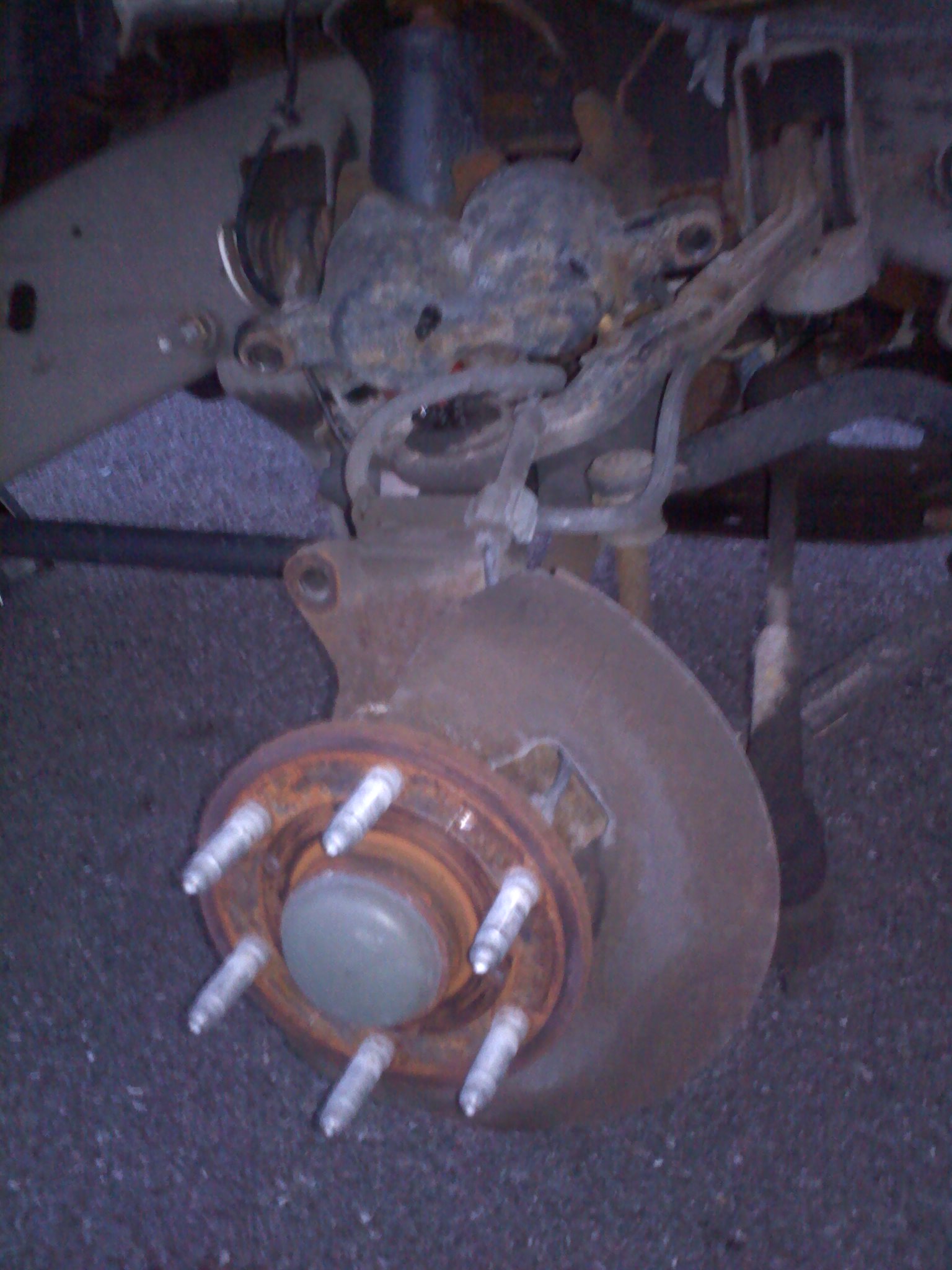
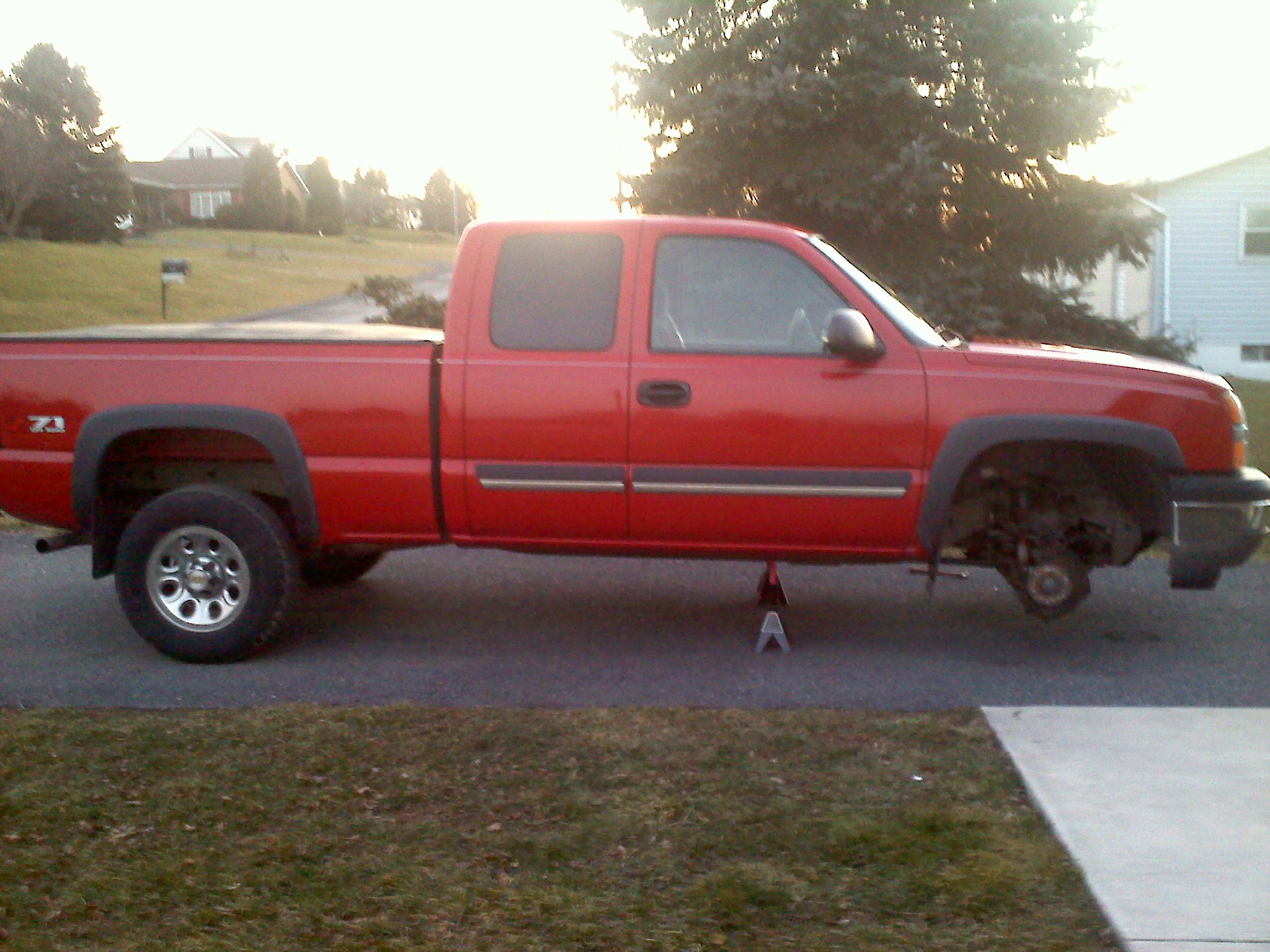
This is what I did this weekend:

There’s a couple reasons why I decided to replace the brake pads and rotors on my 2005 Chevy Silverado myself.  First and foremost because I am a tight wad.  Secondly, I like a challenge every now and then.

When I was growing up my dad did a lot of repairs around the house.  They never went all that well, the process that is, not necessarily the final result.  He did plumbing, drywall, electrical, you name it.  My dad was not a jack-of-all-trades by any means.  We just didn’t have all that much money.  If we needed something done around the house it was far less expensive to do it ourselves.  My dad was frugal.  I remember thinking at some point in my childhood that someday I wanted to be rich enough that I could pay people to do this kind of work for me.  Most of the time that is what I do but no, I am not rich.

About a month ago I took my truck to the garage to be inspected.  The call from the mechanic indicated about $1000 dollars in repairs in order for a new sticker to be placed on the truck.  Five hundred of those hard earned dollars were for new brake pads and rotors.  I had seen my father-in-law do this job and it didn’t seem impossible.  My dad never messed with vehicular repairs aside from changing flat tires.  One advantage that I had over my dad was the internet and YouTube.  I spent a couple weeks reading articles and watching videos and determined with only a shadow of a doubt that I could complete this repair on my own.  I also talked to several of my colleagues.  Some laughed, some thought I was crazy, one said with a snicker that she appreciated my confidence.

Confidence is the key here.  I guess confidence can be misguided but it can also be underutilized.  This is where the second reasoning for this DIY project comes in.  Projects like this, putting yourself out there more than usual, can build confidence.  It’s basically a mini-lesson in building confidence for other parts of your life.  Of all the people I know, only a couple had ever attempted to change their own brakes.

As always, the genesis of any DIY project takes courage.  You are taking the BRAKES off of your car!  You know you need those to drive, right?  Is my lack of ability going to end up costing me more in the end.  It took me half of a day to take off one wheel, brake and rotor.  I would do one little part and then fight with myself about whether I had the ability to finish.  At one point I was looking up the phone number of another mechanic.  Then one major task was completed and my confidence went up.  Another one and another one followed.  I did have to call a friend when I stripped off a screw but other than that I completely removed the first wheel – tire – rotor combo in about four hours. I celebrated a little in my mind and then removed the combo from the other side – in 20 minutes.  My confidence was rewarded.  I was flying high.

It was like a microcosm of my professional life.  The victories are far apart sometimes but when they occur I get that some feeling of powerfulness.  That is the reason that I enjoy doing DIY projects.  The rewards come quickly and you know that everything is of your doing.  Good or bad, it’s on you.  My spirit seems renewed each time.

The job isn’t done yet.  As you can see from the photo, the brakes aren’t back on.  Tomorrow will hopefully bring those victories.

By the way, don’t tell my father-in-law yet.  He doesn’t know what I’m up to.